Installing a yurt in France: planning rules and procedures

You can install a yurt in France. The steps you need to take depend mainly on how you plan to use it, how long it will be in place, what facilities it will have and which planning rules apply to the site.
A yurt used occasionally in a garden does not necessarily require the same formalities as one fitted out as a main residence, tourist accommodation or business premises.
First step: contact your local mairie
Before installing a yurt on a lasting basis, we recommend outlining your plans to the planning department of the local mairie (municipal authority).
The mairie can check:
- the local development plan (plan local d’urbanisme, or PLU) or the municipal planning map (carte communale);
- how the land is zoned: urban, agricultural, natural or protected;
- how long the yurt will be in place and how you plan to use it;
- its size and any fittings or improvements;
- local rules on water, sanitation and electricity.
This consultation will usually establish quickly whether any formalities are required and, if so, whether you should submit a prior declaration (déclaration préalable), apply for a development permit (permis d’aménager) or, in some cases, apply for a building permit (permis de construire).
Installing a yurt temporarily
A traditional yurt that can be dismantled and is put up for a limited period may be treated as a tent, particularly if it has no permanent fittings.
A genuinely temporary installation may be exempt from formalities in many situations. However, special restrictions may apply in protected areas, near historic monuments, on the coast or in certain natural areas.
It is therefore advisable to check with the mairie even if you intend to use the yurt only seasonally.
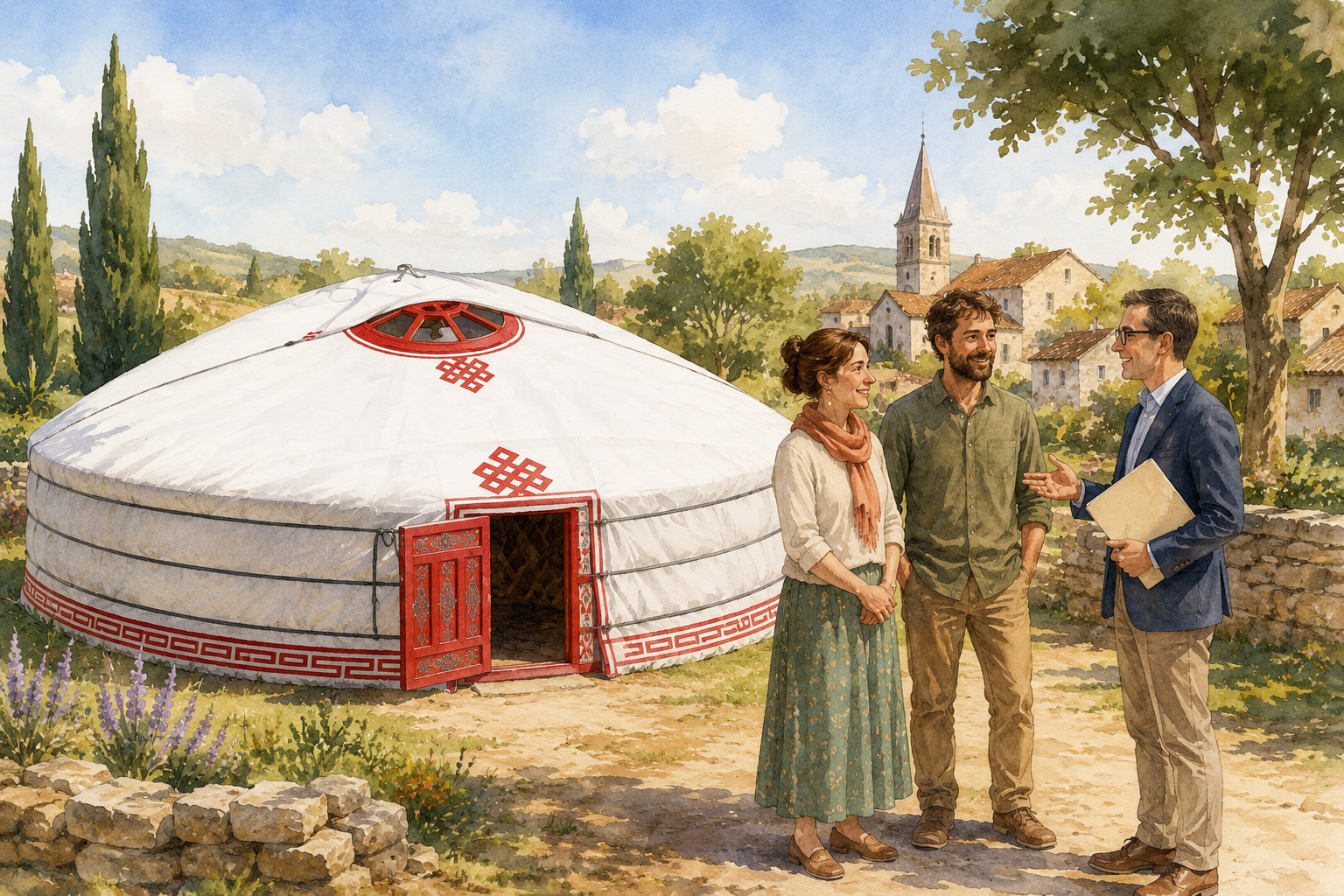
Using a yurt as your main residence
French law recognises dismantlable dwellings that serve as their occupants’ permanent homes. These are installations that:
- have no permanent foundations;
- can be dismantled quickly and easily;
- are intended to be occupied as a main residence for at least eight months a year;
- may have indoor or outdoor facilities and can operate independently of public utility networks.
Planning documents may designate land where this type of housing is permitted. Depending on the number of dwellings, their total area and how the land is developed, the project may require a prior declaration or a development permit.
Flooring, fixed utility connections, a kitchen, sanitary facilities or other lasting fittings may also affect how the project is classified and which procedures apply.
Using a yurt for business or tourism
A yurt can be used for many activities: tourist accommodation, a wellbeing space, an activities room, a professional practice, a workshop or an events venue.
In addition to planning rules, the project may have to meet other requirements specific to the activity, covering:
- fire safety;
- accessibility for disabled people;
- occupancy capacity;
- electrical and heating installations;
- toilets and wastewater disposal;
- the rules for premises open to the public (établissements recevant du public, or ERP), where applicable.
These requirements depend on how the yurt is used and how many people it accommodates. The mairie and, if necessary, the departmental fire and rescue service can advise the person responsible for the project.

Does the land have to be designated as suitable for building?
That depends on the intended use and the local planning rules. An agricultural or natural zone does not automatically allow a dwelling, even if it can be dismantled.
However, some planning documents may designate areas suitable for dismantlable dwellings or for tourism and leisure activities. Each site must therefore be assessed individually.

What to prepare for your project
To get a clear answer from the mairie, it helps to provide:
- the site address and cadastral reference;
- the diameter and area of the yurt;
- how long it is expected to be in place;
- the intended use: leisure, a home, letting or business;
- details of any flooring, heating or utility connections;
- a few photographs or a site plan.
In most cases, this initial enquiry is enough to identify which procedure applies.
The rules depend on the project
No single authorisation applies to all yurts. The rules reflect the circumstances of each installation: a small yurt put up occasionally, a dismantlable main residence and a room open to the public are three different projects.
The best approach is to define exactly how the yurt will be used, then ask the mairie to confirm that the proposed siting is acceptable before starting any site development work.
This information is for general guidance and is not a substitute for advice from the planning department responsible for the site.