Mongolian yurt FAQs
Mongolian yurts | Mongolyurt
How long does a yurt last?
It’s hard to give a precise answer. In Mongolia, people say 50 years. We’ve done everything we can to make our yurts to a high standard and adapt them to climates wetter than Mongolia’s. With a little care, the timber frame and felt will last for many years. If you do run into a problem after a few years, with a cover for instance, we always keep these parts in stock at competitive prices.
These lifespans are estimates, not guarantees. They can vary considerably depending on the climate, exposure, installation and maintenance.
Do the yurts come with a guarantee?
Each yurt is made by hand. We’ve paid close attention to the quality of our yurts since 2003, but we can’t guarantee how they will perform in use. In the unlikely event of a problem, we’re always on hand with advice or spare parts.
Are the yurts waterproof?
Our yurt kits include a rainproof layer that sits between the felt and the outer cover for extra protection from the weather. Good ventilation and regular heating are still essential, especially in damp weather.
Can the yurt withstand strong winds?
Yurts were developed on steppes where winds can be extreme. Their aerodynamic shape lets them withstand very strong winds even though they are not anchored to the ground (Mongolian tradition is to leave the earth undisturbed). In very strong winds, a large stone is tied to the rope hanging from the centre of the tonoo (roof crown, also written toono). Make sure the yurt is well sealed at floor level so wind cannot get underneath.
Can the yurt withstand heavy snow loads?
A properly assembled yurt can normally withstand even very heavy snow loads. To be on the safe side, we recommend clearing snow from the roof regularly. If you’ll be away for a long time, add 2 temporary support posts (at the 6 and 12 o’clock positions) on yurts with up to 6 walls.
What is included in the price of a yurt?
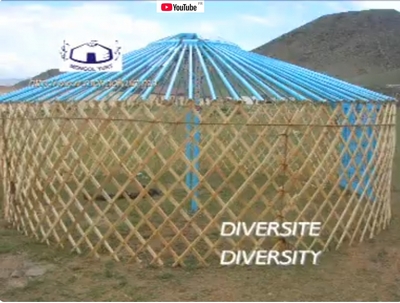
The frame includes lattice walls, roof poles, the toono (roof crown), two central posts (four on models with 10 walls or more) and a single door. Models with 4 walls or more also come with a pair of glazed doors. The four openings in the toono have removable covers: three fitted with thick transparent film, and one with a hole in a metal plate for the stove flue. The kit also includes washed felt for one standard layer over the walls and roof, a polyester–cotton inner liner of about 140 g/m², a berdzine-type outer cover (weather-facing canvas) of about 380 g/m², a rainproof layer between the felt and the outer cover, a set of ropes, a decorative protective skirt around the base and a square roof flap. The ropes may be made of horsehair, synthetic fibres or other materials, depending on availability.
Curtains, the platform and furniture are not included, but can be ordered separately.
Does your felt come from Mongolia?
Yes. It’s a very dense, washed felt made to resist moisture particularly well.
Are there any windows?
In Mongolia, the tonoo (roof crown) and the door usually serve as windows. On models with 4 walls or more, we’ve added a pair of glazed doors just behind the main door. They let in more light and give you a view without altering the traditional character of the Mongolian yurt. You can order windows from us. The size of the yurt determines how many windows or doors can be fitted.
Is the roof crown glazed?
The toono (roof crown) has four openings on the side facing the main door, each with a removable cover. Three are fitted with thick transparent film to let in light; the fourth has a hole in a metal plate for the stove flue. There is no glass glazing. The rear is usually covered by the urkh (square roof flap).
Do the yurts need maintenance?
Like any home, a yurt doesn’t take well to being left unused. It will last longer if it is used, aired, heated or some combination of the three. We suggest reproofing the outer cover, or at least its seams, once a year and checking that the ropes are tight. If you’ll be leaving your yurt for several months, we recommend taking it down (it’s easy to do) and storing it somewhere dry.
In summary:
Mongolian yurts are made by hand from natural materials such as wool, timber and leather.
A yurt is exposed to the weather and to changes in temperature, so how long it lasts depends largely on how it is used and looked after.
Experience has led us to adapt parts of the frame so the yurt stands up better to oceanic and temperate climates.
To keep out rain, we recommend using the rainproof layer supplied with our yurt kits. It goes between the felt and the outer cover.
Even so, heat and air the yurt at least once a week, or daily in poor conditions such as rain, fog or wet ground.
Putting the yurt on a floor considerably extends its life.
In Mongolia, the timber in an occupied yurt lasts 50 years and the textiles 10 to 15 years.
We estimate that in an oceanic climate, a yurt left up through the wet season will last about half as long, even if it is looked after weekly in line with our advice. If left unattended, it may last well under two years.