The quality of our yurts
See what our yurts are made of and how we check them before shipping.


Timber components
We use timber to make the following parts:
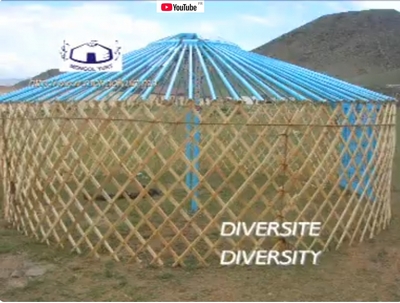
• the lattice wall sections (Xana)
• the pair of glazed doors (Xaalga)
• the roof poles (Uni)
• the roof crown, which acts as a compression ring (Toono)
• the central support posts (Bagana)

Birch, pine or larch can be used, depending on how much flexibility and strength each part needs.
Today we use only Siberian pine for our timber components to help protect other wood species.
We treat the timber with water. It is soaked for several days (up to 14), dried, then soaked again, and the cycle is repeated. We have our timber cut and shaped 700 km from the capital and use water from a hot sulphur spring for this process.
After a few rounds of soaking and drying, the resin comes out as a paste rather like wallpaper paste. The result is dry, strong, very light timber that’s ready to paint.
The timber is shaped by hand along the grain, which accounts for the occasional irregularity.
Avoid machine-shaped timber, particularly for lattice walls and roof poles. The telltale signs are feed-wheel marks and perfectly rounded edges, but the timber is brittle.
The lattice walls should be tied together with camel-hide laces. Cowhide and yak hide are also used, but they become too stiff when dry and can snap.
We paint the timber in our workshop in the colours you choose. We apply two coats of German, Korean or Polish paint and use Korean varnish. Chinese paint is cheaper, but the paint available in Mongolia is of much lower quality.
Textile components
The fabrics and felt keep the weather out and insulate the yurt.
Felt
Our yurts come with one layer of felt as standard. In Mongolia, two layers may be used when the felt is thinner, at around 6 to 7 mm. We can supply an extra layer on request, depending on how you’ll use the yurt and the local climate.
Traditional greyish felt is prized in Mongolia, but it has a strong smell that intensifies when damp. We use high-quality washed felt instead, for its proven insulating properties.

Outer canvas
The outer canvas plays an important role and needs to be chosen carefully.
There are two natural-fibre options available in Mongolia:
Khaki green canvas (Chinese or Russian), which lets water through easily
White canvas (Russian or Korean), which is much more expensive but far more resistant to moisture.
The outer canvas traditionally used in Mongolia is thinner (a fabric known as bouresse). For our yurts, we use a berdzine-type outer canvas weighing around 380 g/m² instead.
Inner lining
The polyester/cotton lining weighs around 140 g/m². It sits between the wooden frame and the felt, keeping loose felt fibres out of the interior and showing off the criss-cross pattern of the lattice walls.
Roof flap (urkh) and yurt skirt (rayartch)
The roof flap is made from the same fabric as the waterproof cover and keeps rain from getting in through the toono (roof crown). It can be closed in cold weather or heavy rain, but is usually left half open in fine weather.
The yurt skirt is a decorative strip of canvas that protects the base of the yurt from rain splash. It’s easy to wash.
Both pieces help protect your yurt from rain and damp.
Ropes
The ropes come in different thicknesses depending on their purpose. They may be made from horsehair, synthetic fibres or other materials, depending on availability.
All the parts listed above can be bought separately as spares.
Windows
The four openings in the toono (roof crown) on the side nearest the main door have removable covers. Three have thick transparent film to let in light. The fourth has a metal plate with a hole for the stove flue.

Quality checks

We assemble every yurt before loading it into the shipping container.
This takes time, but it lets us check that all
parts are present, that they fit together properly and that they
meet the specifications we’ve agreed with you.
We number the parts where the markings won’t show once the yurt is up, 
so you can assemble your yurt more easily later on.
We then take the yurts down and pack them for shipping. 
You’re welcome to watch the process, which takes 2 days for a full container. If you can’t make it, we can send you photos.
Shipping, customs and delivery
The container travels by train to Dalian, a port in northern China. From there, your yurts go by sea to Le Havre, Vancouver, Los Angeles or Hamburg. As soon as the container arrives and clears customs, it goes by lorry to one of our warehouses or straight to you if you’ve ordered a full container.

We can then deliver the yurt to you for an additional charge. Please contact us with your postcode for a quote.
We can also arrange air freight, although it is very expensive.
We take care of transport and customs clearance.
You can order just one yurt.
As a guide, your yurt should arrive within 90 to 120 days, with taxes included. Transit times may vary with distance, customs and other formalities, and international conditions.
That’s all there is to it.
Photos are for illustration only. As our products are handmade, colours, patterns and finishes may vary from one piece to another. Some photos show optional features or furnishings not included as standard. Your quote sets out the specifications and equipment included in your order.